Lordship Qualification Rule
The Legend of William OhThe Lordship Qualification Rule is the Tower-governed threshold that converts a Climber’s following into recognized lordship. It requires a minimum number of Vassals, but numerical sufficiency alone does not complete the process: The Tower also scans the surrounding Territory for an existing claim or residents before permitting the candidate to establish a Demesne. Lordship therefore combines human submission, territorial availability, and administrative recognition.
Definition and System Operation
The rule appears as an explicit system judgment rather than as a custom whose meaning must be inferred. When Mark has assembled the required following, The Tower announces that he has reached “the minimum amount of Vassals to be considered a Lord.” It then scans the local Territory, finding neither a prior claim nor residents, and asks whether he wishes to establish the location as his Demesne. The wording separates qualification from territorial establishment: the Vassal threshold makes lordship possible, while the vacant territory makes a particular lordship claim valid.
This procedure places political advancement inside the same operational framework that governs Classes, Abilities, Quests, Charges, and other aspects of Climber life. A sacrifice can be consumed by an Altar and still fail to generate a Class Seed when it is judged suboptimal; the system can request Primary Abilities; and new Quests can appear after prior achievements. In the same manner, lordship is not created solely by self-description or public confidence. It is a status produced when stated conditions are met and acknowledged by The Tower.
Vassals as the Required Political Resource
Mark’s qualification demonstrates what the rule counts as proof of authority. He selects twelve young Climbers to become his first Vassals and orders them to swear fealty. The ceremony is abbreviated: he skips much of the prepared grandstanding and speech, while Old Bron notices the omission but does not interrupt. Even without elaborate rhetoric, the selected Climbers kneel together and pledge their lives to Mark’s service as Vassals, with The Tower named as witness.
Their oath is therefore more than a ceremonial display. It is the collective act that supplies the measurable condition for recognition. The twelve Climbers are not merely companions, employees, or temporary members of a Party; they become the institutional foundation of Mark’s claim. The rule transforms a personal following into an official political quantity, making the bodies and promises of the Vassals legible to the system.
The requirement also clarifies why Vassalage is consequential. Earlier discussion establishes that powerful groups can force talented Climbers to become Vassals, thereby ending their possibility of pursuing Lordship themselves, or kill them instead. When Will asks whether someone can simply be forced into Vassalage, Steve points to Will’s tomahawk and the coercive arrangement they have just imposed on a Healer. The exchange reveals that the same status which qualifies one person for lordship can foreclose another person’s independent political future. Vassalage is thus both allegiance and lost eligibility, depending on which side of the arrangement a Climber occupies.
Territorial Validation and Establishment of a Demesne
The rule does not allow a candidate to convert any assembled group into a domain wherever desired. Once Mark meets the Vassal minimum, The Tower checks the local Territory. The scan finds no previous claim and no residents, removing the immediate obstacle to establishing authority there. Only after this check does the system present the decision about creating a Demesne.
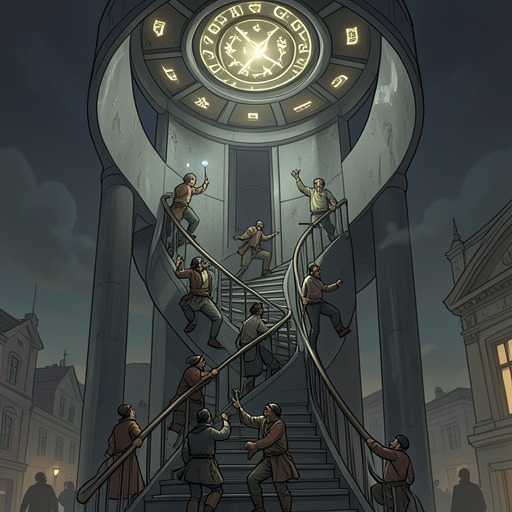
Mark accepts. He walks up the stairs to the throne overlooking the responsibility he has acquired, and The Tower immediately confirms that it acknowledges him as a Lord. The sequence gives territorial rule a concrete administrative shape: Vassals satisfy the social condition, the absence of a competing claim satisfies the territorial condition, Mark’s decision supplies consent to the establishment, and the system’s congratulations completes recognition.
The vacant-site requirement also limits the apparent freedom of political expansion. A local claim or resident population would have mattered even after Mark had gathered enough Vassals. Lordship is consequently not just a reward for recruitment; it is a regulated relationship among a claimant, sworn followers, and a place that can legally or systemically be made into a Demesne.
Consequences for Power and Narrative
The rule makes authority look both grand and procedural. Mark’s accession culminates in a throne, a new responsibility, and The Tower’s formal congratulations, yet the decisive evidence is a count of Vassals and a territorial scan. The contrast gives the moment its characteristic irony: the passage toward sovereign power is framed less as inherited majesty than as compliance with an interface that verifies inputs and returns a status.
That procedural quality also explains the rule’s importance to the wider Climb. Climbers receive Quests, level-based recognition, and advancement prompts, but progress is never purely personal. Reaching level five on an Establishing Quest produces a new directive to ascend to the 2nd Floor and places Will at rank 1053rd among that year’s Aspirants. Such notices turn achievement into system-readable placement. The Lordship Qualification Rule extends the same logic from individual advancement to political organization, showing that even a throne must be earned through recognized prerequisites.
The rule therefore defines lordship as a conditional form of power. Mark can command, but recognition depends on others’ sworn lives, an unclaimed Territory, and The Tower’s acknowledgment. Its decisive effect is to make governance simultaneously social and mechanical: authority is built through human allegiance, but it becomes real only when the governing system accepts the arrangement.